
The Timing Mistake Making Gut Issues Worse
When you eat affects your gut as much as what you eat

Disclaimer: I’m not a medical doctor. This is not medical advice and is for informational purposes only. Everything shared here is based on my personal experience. Always do your own research and consult a qualified practitioner before making changes to your own routine.
Most people focus on what they eat. Very few think about the importance of when they eat.
Your gut doesn’t just care about the food. It cares about the timing. And when timing is off, it can cause a lot of issues.
Bloating that’s worse in the morning despite not eating for hours
Reflux that only hits certain nights
IBS that flares without obvious triggers
Brain fog that doesn’t match your sleep timing or quality
Food cravings that come out of nowhere
For many people, these trace back to a timing problem that they’ve never considered.
Your digestive system runs on a schedule. When you ignore it, you disrupt the biological systems that determine whether your gut functions properly.
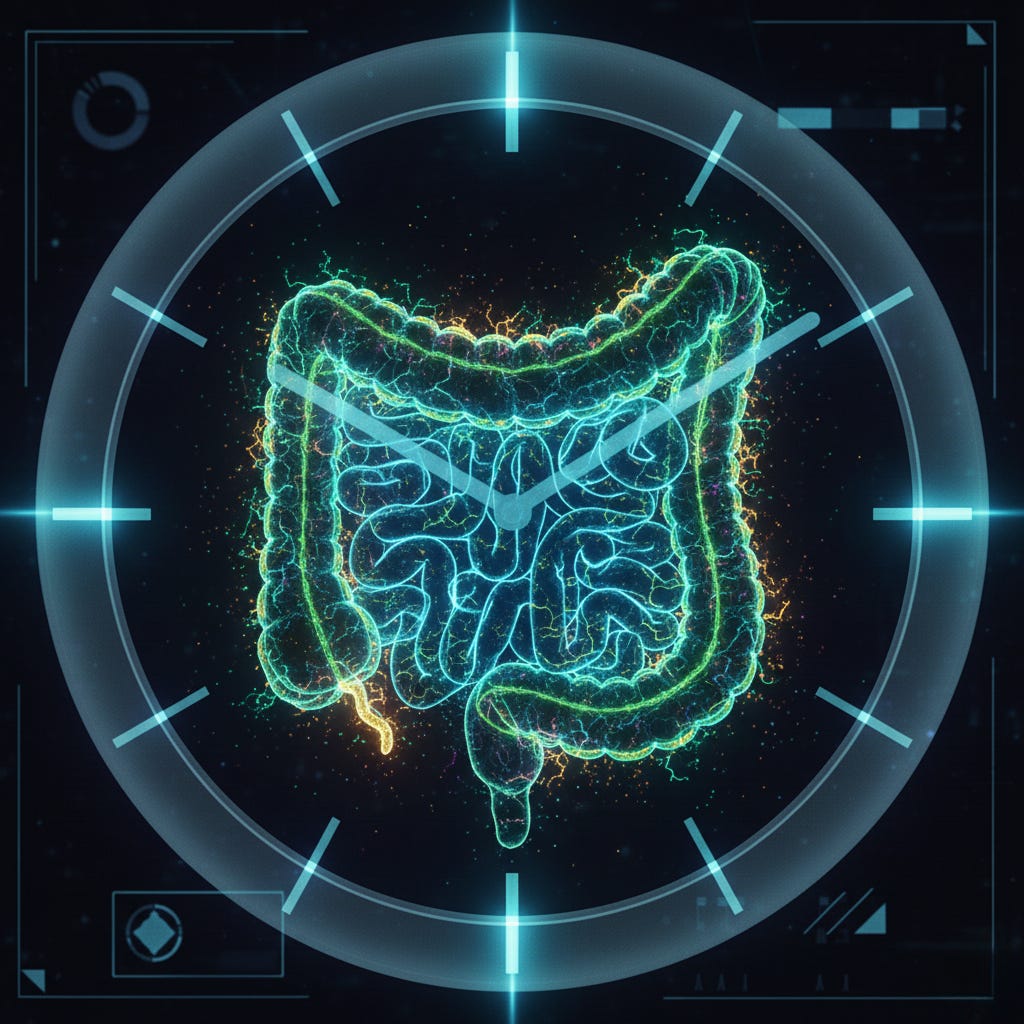
Your Gut Runs on a Clock
Your brain has a master clock driven primarily by light. It tells your body when it’s day and when it’s night. But your gut, liver and pancreas have their own clocks. These peripheral clocks sync to a different signal: food.
When you eat late, you create a timing conflict. Your brain says it’s nighttime (wind down, repair, sleep). Your gut says it’s daytime (digest, absorb, metabolize). This mismatch is much more disruptive than people realize.
Your gut isn’t just “less efficient” at night. The entire digestive landscape shifts:
Stomach emptying slows: Food sits longer, ferments more, produces more gas.
Enzyme release changes: You’re not producing the same digestive output at 10pm that you produce at noon.
Motility drops: The muscular contractions that move food through your intestines are circadian-regulated. Late meals fight against the current.
Immunity shifts: Your gut immune system has daily rhythms. Circadian disruption tips it toward inflammation.
The same meal eaten at 6pm versus 10pm has significantly different metabolic outcomes. Not because the food changed, because your body’s readiness to process it changed.
Sleep Take a Hit (and your gut pays twice)
Most people think late eating just makes it harder to fall asleep. That’s the surface problem. The deeper issue is what happens to sleep quality even when you do fall asleep.
A randomized crossover study compared routine dinner (about 5 hours before bed) with late dinner (about 1 hour before bed). Late dinner shifted sleep cycles: deeper sleep came earlier, lighter sleep dominated the back half of the night. Same sleep duration, different sleep quality. (PMID: 34017207)
Three mechanisms drive this:
Nervous system can’t serve two masters: Digestion requires sympathetic activation (the “on” state). Sleep onset requires parasympathetic dominance (the “off” state). When you eat close to bed, you’re asking your body to rev up and wind down simultaneously. The wind-down loses.
Digestion generates heat at the wrong time: Your body naturally drops its core temperature to initiate sleep. This cooling signal is part of what makes you drowsy. Digestion is thermogenic, meaning it produces heat. Late meals blunt the temperature drop your brain is waiting for.
Blood sugar and heart rate fluctuations: Large or carb-heavy late meals can trigger brief awakenings you won’t remember but that still disrupt sleep. Your heart rate and metabolic activity spike and dip throughout the night instead of staying stable.
The result is that you sleep, but you don’t recover.
Next-day symptoms include heavier morning grogginess, stronger cravings (especially for quick carbs), and lower stress tolerance. And because gut repair happens primarily during deep sleep, your gut pays for the disruption twice: once from the late meal itself, and again from the impaired recovery window.