
Why your brain isn't working like it used to
The important connection most don't consider

Disclaimer: I’m not a medical doctor. This is not medical advice and is for informational purposes only. Everything shared here is based on my personal experience. Always do your own research and consult a qualified practitioner before making changes to your own routine.
Anna is a 34-year-old I connected with recently. She works in marketing, is sharp, a high-performer, the kind of person you can just tell is intelligent and successful within the first few minutes of conversation.
Or she used to be.
For the past two years she’d been leaving work meetings with no memory of what was discussed. She’d read the same email three times and still not comprehend it. Some days the brain fog was so bad she wondered if something was seriously wrong with her neurologically.
She’d also get bad bloating after certain meals. Had unpredictable urgency from time to time. Hadn’t felt truly comfortable in her body in a while.
Her gastroenterologist told her the digestive issues were IBS. Her GP suggested she might be dealing with too much stress and recommended therapy.
The idea that these might be connected was never discussed.
That’s the thing about the gut-brain connection. The symptoms look different enough that nobody connects the dots. But when you understand what’s actually happening biologically, the separation stops making sense.
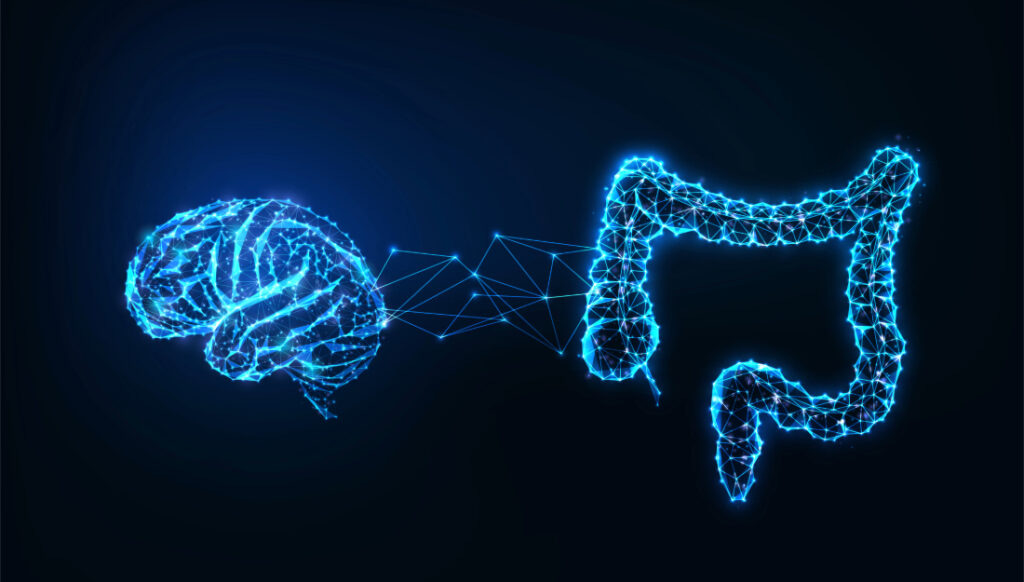
The gut and brain are in constant communication. What happens in the gut influences neurochemistry, drives inflammation, and shapes how you think and feel on a daily basis.
And one of the most important factors in that equation is the gut lining. It’s what stands between the contents of your gut and your bloodstream. When it’s intact, it acts as a selective barrier. When it breaks down, that separation disappears, and things that were never supposed to get through do.
The gut stops being a contained system and starts driving problems throughout the body. Including, in many cases, the brain.
What Leaky Gut Actually Means
Leaky gut is the name for intestinal hyperpermeability. An increase in permeability of the gut lining that allows things to pass through that shouldn’t.
The gut lining is a single layer of epithelial cells connected by tight junction proteins that control what gets through. Under normal conditions, nutrients pass through the cells themselves. The tight junctions prevent everything else, bacterial fragments, undigested food particles, toxins, from slipping through the gaps between cells.
When those tight junctions are disrupted, that protection fails.
This is not fringe science, despite what you may have heard from conventional medicine. The mechanisms are documented in hundreds of peer-reviewed studies at this point.
The key protein is zonulin, a signaling molecule that was discovered by Dr. Alessio Fasano in a paper from 2000 (PMID: 10801176). It directly regulates tight junction permeability.
When zonulin levels rise, it triggers a chain reaction that physically pulls tight junction proteins apart, opening the spaces between cells. Short-term, this is actually believed to be a defense mechanism. It lets the immune system sample gut contents and detect potential threats quickly.
The problem is chronic exposure to modern triggers keeps zonulin high. The junctions stay open. And a short-term defense mechanism becomes a chronic liability.
What Gets Through
When the gut lining is compromised, several things enter the bloodstream that have no business being there.
Bacterial toxins are the most significant. Lipopolysaccharides (LPS), which are fragments from the outer membrane of certain bacteria, are one of the worst inflammatory triggers known. Other bacterial components like peptidoglycans and flagellin also cross a leaky gut.